
Investigation and treatment of dry eyes.
Dry Eye Diagnosis & Assessment
Understanding the cause of your dry eye
Dry Eye Investigation & Assessment
Understanding the cause of your dry eye
Effective treatment starts with an accurate diagnosis.
Dry eye is not a single condition — it is a combination of:
Tear film instability
Inflammation
Meibomian gland dysfunction
Ocular surface damage
Our assessments are designed to identify which of these is affecting you, so we can deliver the most effective treatment.
Dry Eye Assessment Options
Clinical Dry Eye Assessment — £150
A detailed, clinically led evaluation using advanced imaging and tear film analysis.
This assessment is ideal for:
Mild to moderate dry eye
First-time patients
Screening and early diagnosis
What this assessment includes
Meibomian Gland Imaging (Meibography)
Infrared imaging to assess gland structure and survival.
Why it matters:
Healthy glands are essential for a stable tear film. Loss or dropout affects long-term prognosis.
Meibomian Gland Opening Analysis
High-definition eyelid imaging to detect gland blockage (capping).
Why it matters:
Blocked glands prevent oil release, leading to evaporative dry eye.
Ocular Redness Analysis
Automated imaging to differentiate visible blood vessels from inflammation.
Why it matters:
Increased vascular activity is a key driver of chronic dry eye.
Corneal Staining Analysis
Fluorescein imaging to assess surface damage.
Why it matters:
Highlights areas where the tear film is failing to protect the eye.
Tear Film Lipid Layer (Tearscope)
Assessment of the oil layer of your tears.
Why it matters:
A poor lipid layer leads to rapid tear evaporation.
Tear Meniscus Height
Measurement of tear volume.
Why it matters:
Indicates whether your eyes produce enough tears.
Non-Invasive Tear Break-Up Time (NITBUT)
Measures how long your tear film remains stable.
Why it matters:
Short break-up time leads to fluctuating vision and discomfort.
Exploratory Gland Expression
Assessment of gland function and oil quality.
Why it matters:
Helps determine whether glands are blocked, inactive, or recoverable.
Your Personalised Report
Following your assessment, we generate a detailed report including:
Diagnosis of your dry eye subtype
Identification of underlying causes
Clinical images and findings
Recommended treatment pathway
This forms the foundation of your treatment plan.
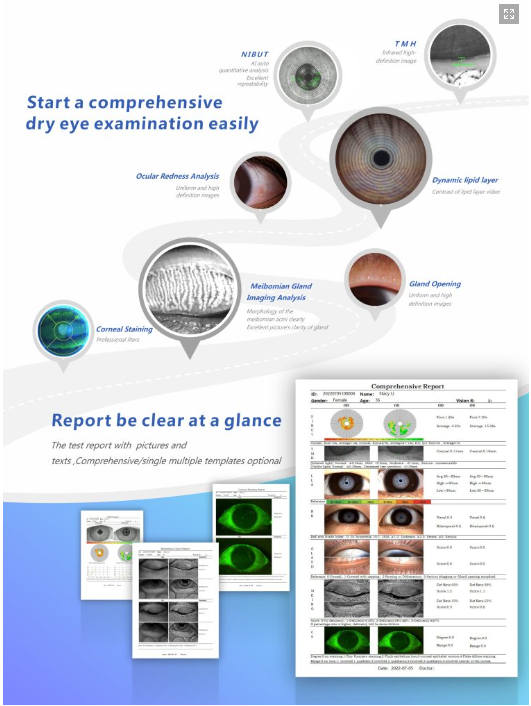
Example dry eye report
Advanced Dry Eye Assessment — £250
Including Laboratory Biomarkers
For more complex or persistent cases, we offer an enhanced assessment.
This includes everything in the £150 assessment, plus:
Advanced inflammatory biomarkers
Tear quality analysis at a molecular level
Deeper insight into disease severity and progression
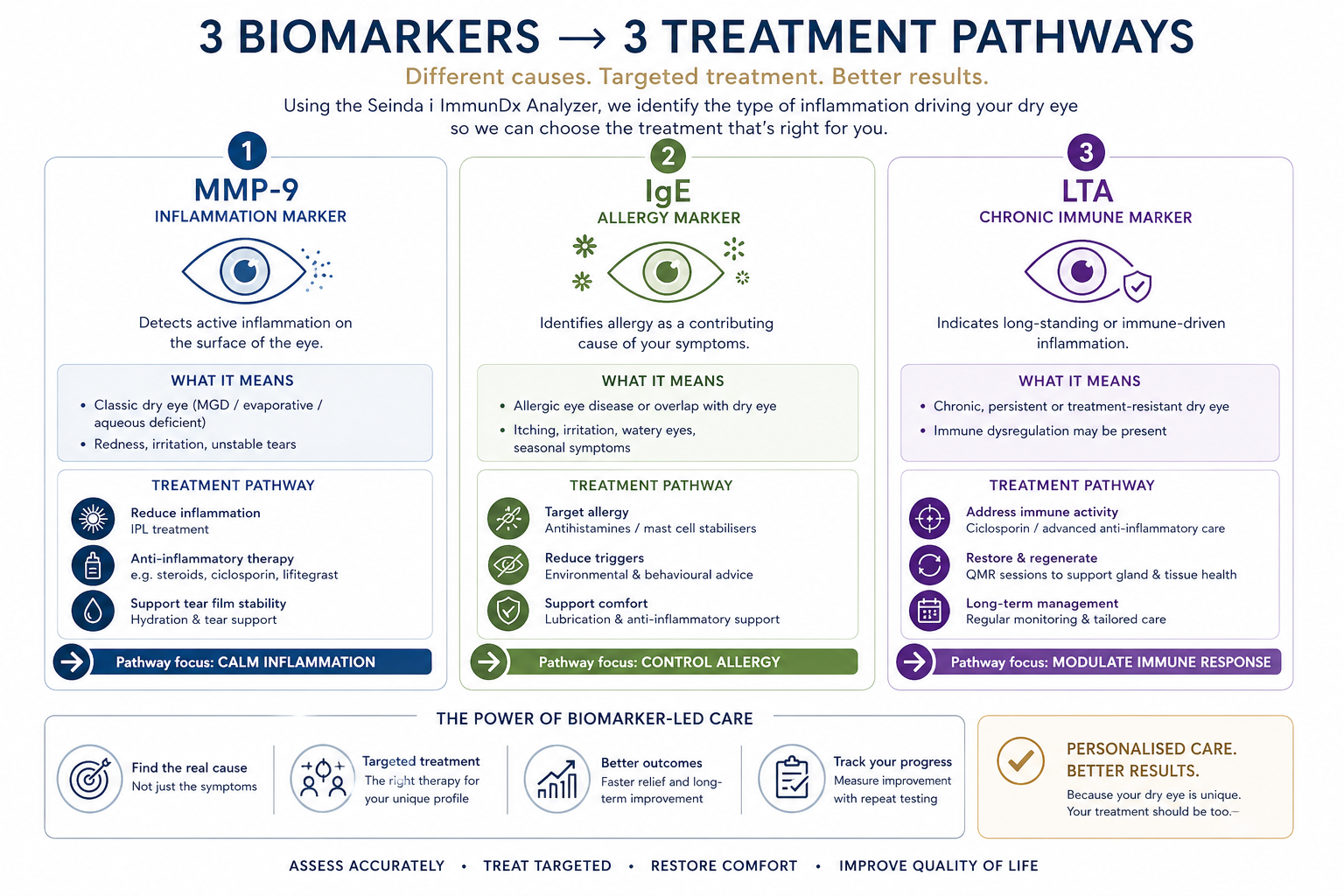
Why upgrade to the Advanced Assessment?
More precise diagnosis
Better treatment targeting
Improved outcomes with IPL + QMR programmes
Particularly useful for moderate to severe dry eye
From Diagnosis to Treatment
Once we understand your condition, we move into a structured treatment pathway:
Reduce → Clear → Restore
Reduce inflammation (IPL)
Clear gland obstruction (Expression)
Restore gland function (QMR)
This ensures treatment is not just symptomatic, but corrective.
The Goal
Our aim is simple:
Relieve your symptoms
Restore tear film stability
Improve long-term eye health
Next Step
Book your assessment to begin your personalised treatment journey.
