
Investigation and treatment of dry eyes.
Management of dry eye syndrome typically involves addressing the underlying causes, managing symptoms, and improving tear production or quality.
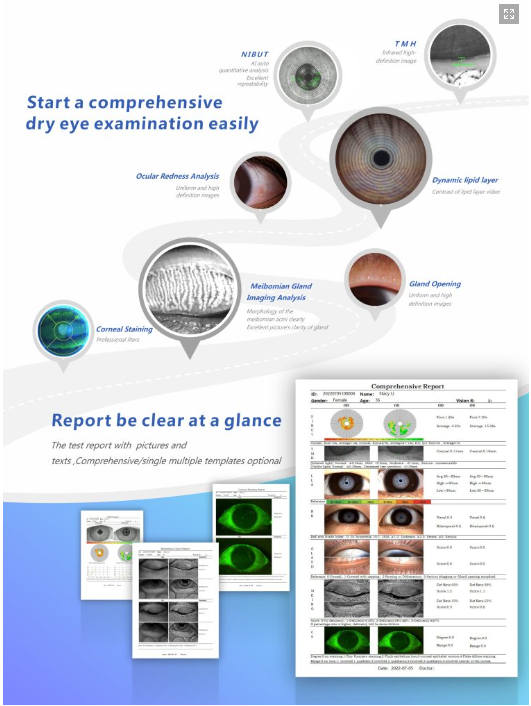
Example dry eye report
Dry Eye Investigation & Assessment
Understanding the cause of your dry eye
Effective treatment starts with an accurate diagnosis.
Dry eye is not a single condition — it is a combination of:
Tear film instability
Inflammation
Meibomian gland dysfunction
Ocular surface damage
Our assessments are designed to identify which of these is affecting you, so we can deliver the most effective treatment.
Dry Eye Investigation & Assessment
Understanding the Cause of Your Dry Eye
Effective treatment starts with an accurate diagnosis.
Dry eye is not a single condition. It is often caused by a combination of:
Tear film instability
Inflammation
Meibomian gland dysfunction
Ocular surface damage
Our assessments are designed to identify the underlying causes of your symptoms, allowing us to create a personalised treatment plan focused on long-term improvement rather than temporary relief.
Advanced Dry Eye Assessment — £250
Including Laboratory Biomarkers
Our most comprehensive dry eye evaluation, designed for patients seeking the most detailed understanding of their condition.
This assessment combines advanced imaging, tear film analysis and laboratory biomarker testing to provide a complete picture of ocular surface health.
Includes:
Detailed Clinical Consultation
A thorough review of your symptoms, medical history, lifestyle factors and previous treatments.
Meibomian Gland Imaging (Meibography)
Infrared imaging used to assess gland structure and survival.
Why it matters: Healthy glands are essential for producing the oil layer of the tear film. Gland loss can significantly affect long-term comfort and treatment outcomes.
Meibomian Gland Opening Analysis
High-definition imaging of the eyelid margins to identify gland blockage (capping).
Why it matters: Blocked glands prevent healthy oil flow and are a major cause of evaporative dry eye.
Ocular Redness Analysis
Automated imaging that measures blood vessel activity and inflammation.
Why it matters: Chronic inflammation is often a key driver of dry eye symptoms.
Corneal Staining Analysis
Assessment of ocular surface damage using fluorescein dye.
Why it matters: Identifies areas where the tear film is failing to adequately protect the eye.
Tearscope Lipid Layer Analysis
Evaluation of the oil layer of the tear film.
Why it matters: A poor-quality lipid layer leads to rapid tear evaporation and unstable vision.
Tear Meniscus Height
Measurement of tear volume.
Why it matters: Helps determine whether inadequate tear production is contributing to symptoms.
Non-Invasive Tear Break-Up Time (NITBUT)
Assessment of tear film stability.
Why it matters: Measures how long tears remain effective before evaporating.
Exploratory Meibomian Gland Expression
Assessment of gland function, oil quality and treatment potential.
Why it matters: Helps determine gland viability and likelihood of recovery.
Advanced Biomarker Analysis
Laboratory biomarker testing helps identify the inflammatory processes driving your condition.
These markers provide additional insight into:
Ocular surface inflammation
Allergic eye disease
Chronic immune-mediated dry eye
Disease severity and progression
This information allows treatment recommendations to be tailored more precisely to your individual condition.
Your Personalised Report
Following your assessment, you will receive a detailed report including:
Dry eye diagnosis and subtype classification
Clinical images and findings
Biomarker results and interpretation
Identification of underlying causes
Personalised treatment recommendations
Outcome
A tailored treatment plan designed specifically for your eyes and your symptoms.
Clinical Dry Eye Assessment — £150
A detailed clinical evaluation without laboratory biomarker testing.
Suitable for:
Mild to moderate dry eye symptoms
Initial investigations
Patients not requiring advanced biomarker analysis
Includes:
Detailed symptom assessment
Meibomian gland imaging
Meibomian gland opening analysis
Ocular redness analysis
Corneal staining analysis
Tearscope lipid layer assessment
Tear meniscus height measurement
Non-invasive tear break-up time
Exploratory gland expression
Personalised report and treatment recommendations
From Diagnosis to Treatment
Once we understand the cause of your symptoms, we move into a structured treatment pathway designed to address the underlying disease process.
Reduce → Clear → Restore
Reduce Inflammation
IPL (Intense Pulsed Light)
Targets inflammation and improves the environment surrounding the meibomian glands.
Clear Obstruction
Meibomian Gland Expression
Performed immediately following IPL treatment to clear blocked glands and restore oil flow.
Restore Function
QMR (Quantum Molecular Resonance)
Supports cellular repair, gland recovery and long-term improvement in tear film quality.
Together, these treatments provide a comprehensive approach to managing dry eye disease and meibomian gland dysfunction.
Our Goal
Reduce symptoms
Improve tear film stability
Restore gland function
Improve long-term ocular surface health
Reduce dependence on lubricating eye drops
Ready to Start?
Book your Advanced Dry Eye Assessment and begin your personalised journey towards lasting dry eye relief.
